Showing posts with label 1922. Show all posts

Thursday, September 29, 2016

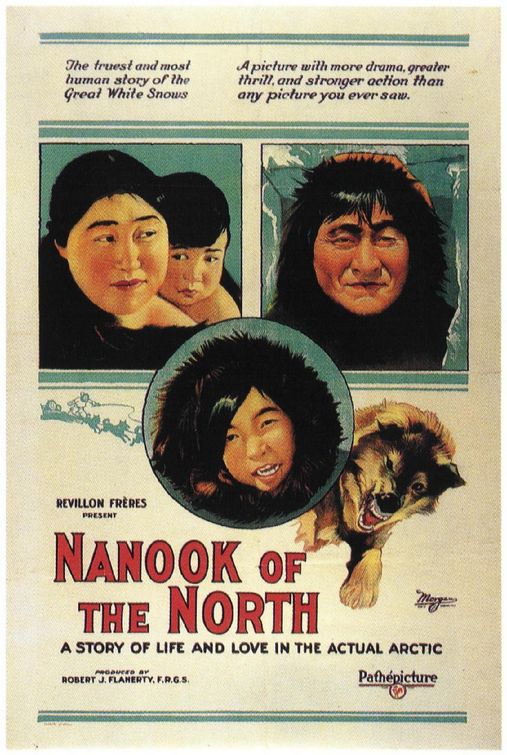
Nanook of the North – The Grandfather of Documentary


I’ve never really been big on the documentary genre. I always became enraptured in film and filmmaking due to my natural gravitation toward strong storytelling. I love being able to delve into the lives of fictional characters, to know that each word, placement, camera movement, lighting adjustment, musical cue, etc. was all placed there with artistic intent. It’s a gorgeous notion and why I, personally, want to be a filmmaker – to be able to tell the stories I want to tell and share my artistic nature with the rest of the world. Be able to make films that others can relate to or affect them the way my favorite films always have.

Documentaries rarely ever fill me with that same sort of effect. Some documentaries do know how to draw the emotions out of me or transport me into their stories, but most of the time they are simply just talking into cameras about facts and numbers, etc. That may be an unfair criticism, but again I don’t criticize these films for being what they are, I simply just don’t flock to go see these films and often shy away from them because it’s a genre I don’t personally enjoy.


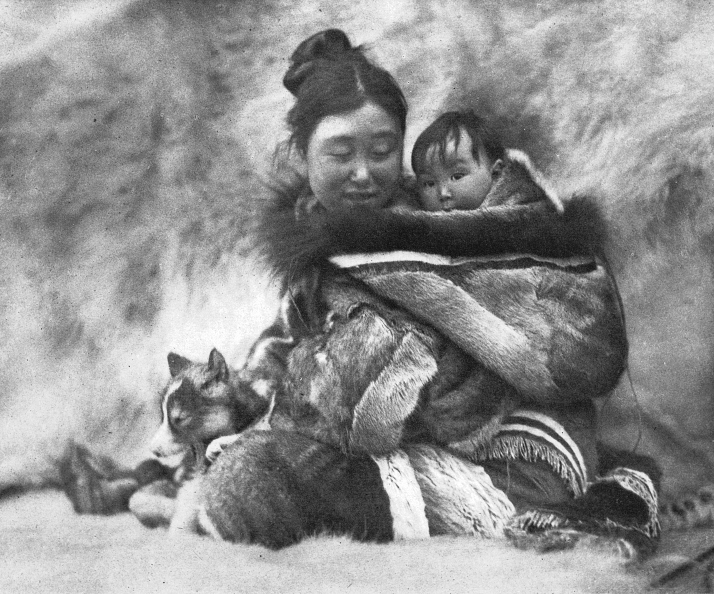
But again, the purpose of this “journey” into film from its roots is to learn and appreciate how all forms of film came to be. This does not exclude documentary. After hearing for years about Robert Flaherty’s Nanook of the North being the pioneer of documentary-style filmmaking, I finally had the opportunity to check it out for myself. The film is pretty self-explanatory: it follows Nanook, an Eskimo living in the North, as he goes about his day-to-day routines of hunting, fishing, eating raw meat, building igloos, and more killing of wildlife.

Flaherty’s approach to filming Nanook is a very simple one and very easy to see why it’s become the norm of documentary filmmaking, like a Birth of a Nation equivalent for documentaries. Flaherty simply stands by and lets Nanook do his whole wildlife-murdering-for-food thing and it’s merely fascinating just watching this specimen go about things in such a different way from ourselves. After a while, you forget you’re watching a film as it feels like you’re right with Nanook and his family shivering your ass off in the deepest parts of the Canadian Arctic. Few films have ever perfectly captured the idea of being truly cold and Nanook certainly is up there despite being a black-and-white film made in 1922.

Though, just like with D.W. Griffith’s pioneering film, Flaherty’s film is not without structural flaws. Most of the film is just spent lingering on this man’s life, showing his day-to-day routines, but we never really get to know him as a person other than what we see him do. Documentary filmmaking has certainly evolved, especially with the advent of sound and color in film, so the idea of digging deeper into the thoughts and ideas of a documentary subject has certainly evolved with it. But that doesn’t dismiss how despite being a well-made documentary, in the same way Birth of a Nation was a well-made fictional film, the lack of a strong emotional core (or in the case of Griffith, a less racist one) forces the film to be forgettable. But again, Flaherty is not a filmmaker by nature, nor is he an artist, he was simply a man with a camera who wanted to show the world this glorious culture he became so enamored by. And that he certainly achieved, along with being the forefather of documentary filmmaking to boot. No big deal. Nanook would certainly be proud.


7/10


Wednesday, September 28, 2016

Sherlock Holmes – Quite Elementary Indeed, Watson


Long before Benedict Cumberbatch or Robert Downey, Jr. would put a modern spin on the classic character of Arthur Conan Doyle’s novels, and even before Basil Rathbone would put his iconic touch on him, John Barrymore (grandfather of Drew Barrymore) would be the first major star to tackle the role of the great private detective, Sherlock Holmes. From director Albert Parker, this now-iconic character is brought to life for audiences in a big way during 1922, and one would think that Holmes would almost be ripe for classic cinema. Especially in the silent era when so much emphasis was given to the star power of actors and the sweeping stories of dedicated directors and writers, one would think that the character of Sherlock Holmes would be right at home in this era. But somehow, the film fails at offering more than your average, dialogue-heavy (which means intertitle-heavy) silent film of the time.

The film follows Holmes – or rather, Barrymore’s interpretation of Holmes – as he attempts to solve the most basic of cases – a stolen wallet and the whereabouts of letters. Yes, as exciting as that sounds, there is actually a great deal more to it. But unfortunately, this is not the Sherlock Holmes character that we have come to know and love. He is not the same character from the novel that is more of a sociopathic, narcissistic, yet cunning, clever, and observantly deductive detective. No, Barrymore’s version is to make him an everyman, a simpleton who solves these two simple cases in order to win the affection of a girl. Watson is merely there to play the “friend” role without any sort of wisdom or insight or really any sort of chemistry at all that makes his character so great. He’s simply there. What’s worse is Holmes is played as someone not even that clever at all. Granted, this film is basically his “origin story,” yet there is only one scene that shows his cleverness, and in fact, plays him as if he is Peter Parker without the super powers.


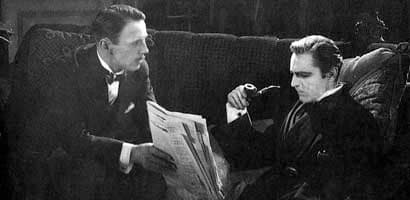
As we all know, though, Holmes is not a superhero who gets bit by a radioactive spider that feeds him intelligence and deductive reasoning; he was born this way. This is who he is. And maybe that’s the biggest reason this film fails in comparison to nearly every other one that came after is that they entirely misunderstood the character. Worse yet, John Barrymore’s (pictured left) take doesn’t help. He’s almost played as an idiot at times with how simple these cases are yet how oblivious he is to the culprits of them, until the script calls for him to finally understand. It’s an odd take on the character, and Barrymore’s performance is only sometimes good (not as over-the-top as I’ve heard he can be which was a surprise), but it’s not enough to make me care about Holmes at all. If this were the first Holmes film I had seen, I probably wouldn’t have dug any deeper into figuring out the character. Which is probably why it took a decade before the character ever found his footing in cinema with Rathbone’s interpretation.


There are positives, however. It’s not a bad film, just a painfully average one considering how great the character and his plights can be. The script is incredibly weak, offering us very little mystery and making fools of such strong characters of the great Dr. Watson and the vile Moriarty (pictured right with Barrymore's Holmes). But the performances from both (Watson and Moriarty) make up for the weak performance at the center of the film and almost tap into what makes them great characters to begin with. The overall make-up, artistic design, and costumes are a marvel as well, perfectly capturing the era.

Overall, though, this film is not a Sherlock Holmes must-see. It almost completely undermines the detailed nature of Sir Doyle’s work and feels like they read the back cover of the book and decided to make up their own idea of who Holmes, Watson, & Moriarty were. And they’re nothing special. Far from it. I would say the only reason to watch this film is if you’re a die-hard Sherlock Holmes fan and a completist (such as myself). Otherwise, there’s no real reason. Even Barrymore’s performance isn’t up to snuff and most of the film is spent just talking about pointless things that have little to do with the case at hand. It sure is a mystery as to what went wrong with this film, but perhaps we ought to put the real Holmes on the case to help us figure it out.


4.5/10